
Finland-Swedish Sign Language Brings Minorities Together – Interpreters Work with Heart and Soul
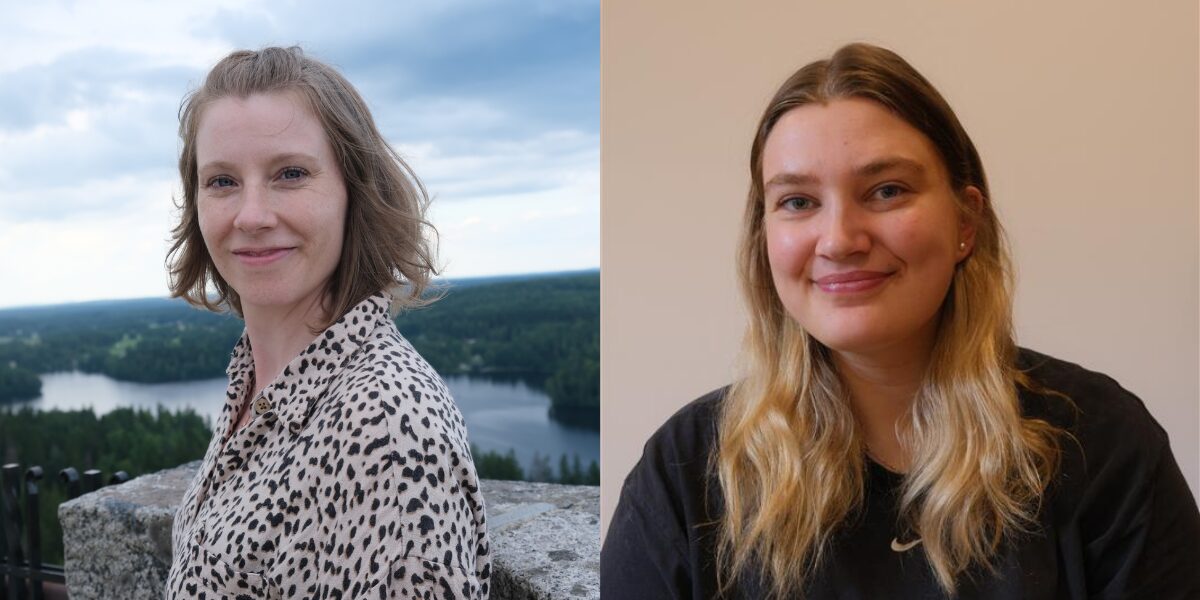
The term “Finland-Swedish Sign Language” may not be familiar to many people.
However, sign language interpreters and Humak alumni Emma Borgman and Ellen Hoang know exactly what it means: a language minority within a language minority. For several years, Humak has been doing frontline work to help preserve Finland-Swedish Sign Language – after all, the issue concerns fundamental linguistic rights.
Both Emma and Ellen are native Swedish speakers who decided to study to become interpreters at a Finnish-language university. How did that work out? What is the best part of working as an interpreter? And how does Finland-Swedish Sign Language appear in the work of multilingual interpreters?
A Winding Path That Led to the Goal
The path to becoming a qualified interpreter is not always straightforward – Emma’s story proves that. After completing her schooling in Swedish, Emma graduated from vocational school as an electrician. A ready-made profession was waiting for her, but her interest in sign language pulled her toward a new adventure.
Today, she and Ellen are colleagues at the Sign Language Cooperative Via. Ellen’s route to becoming an interpreter was more direct and clear – in a way.
“I didn’t originally think I would become an interpreter at all. I was interested in culture and languages. To me, signing appeared as a continuation of those interests – a language where the hands and the body are involved. I thought I would learn sign language and then move on to work as a teacher, psychologist or social worker,” Ellen recalls with a slight laugh.
“Interest in languages in general is actually very common among interpreters. For me, however, it was clear that I specifically wanted to become a sign language interpreter,” Emma adds.
Both feel it is a shame if interpreting is not seen as just as interesting as studying spoken languages. Interpreting is meaningful work – after all, it directly concerns linguistic rights.
A Job Where You See the Full Spectrum of Life
According to both interpreters, one of the best things about their work is its variety. Interpreters get to take part in many different kinds of situations in people’s lives.
“I don’t personally have any pets, but as an interpreter I might accompany a client to the veterinarian. Through my work, I get to be part of situations I would otherwise never experience,” Emma says.
She adds that it is an honor to be present in moments that are important to people – both joyful and difficult ones. Interpreting is a people-centered profession where trust is essential.
“Clients have to be able to trust that we are doing our very best in that moment. The work requires sensitivity, and interpreters often witness very personal matters,” Ellen explains.
Sometimes the work can also bring difficult emotions. As Ellen puts it:
“Sometimes the job is a bit contradictory. It would be wonderful if the world didn’t need interpreters at all – because that would mean everyone understood each other.”
A Small but Special Language Community
For Ellen and Emma, Swedish is their native language. Through personal experience, they both understand what it is like to belong to a linguistic minority. This gives them a sense of connection with clients who use Finland-Swedish Sign Language.
“It’s quite possible that I know my Finland-Swedish Sign Language clients personally. Interpreters may know quite a lot about their clients. That can be a richness, but also a burden. If there were more interpreters of Finland-Swedish Sign Language, clients would have more choice,” Emma explains.
Familiarity can bring a sense of security, but it also requires special sensitivity.
“It’s important to recognize situations where a client would benefit from having another interpreter. Clients must have the opportunity to say: right now, I don’t want you as my interpreter,” Ellen says.
Would the situation improve if more interpreters were trained in Finland-Swedish Sign Language? Ellen’s answer is clear:
“Even one additional interpreter would make a difference. If there were more interpreters, we could specialize in certain topics. We could also choose our assignments more freely – an interpreter who is afraid of dentists might not want to go to the dentist, but if there are no other interpreters available, you go with the client.”
A Mix of Languages
But what about studying in Finnish – how did that go?
“Before Humak, I hadn’t written a single essay in Finnish. But you really do learn the language by doing. At Humak we had a unique community. There was a strong sense of belonging because we were all learning a new language – sign language,” Emma says.
Interpreter studies involve learning several languages at the same time, which can sometimes be challenging. Ellen remembers the first year as particularly demanding.
“I wasn’t used to studying in Finnish, and at the same time I had to learn a completely new language. Even though the other students were very encouraging, my notes sometimes turned into a complete mix of languages. But I think the multilingual environment prepared me well for working as an interpreter,” she laughs.
For Emma, the beginning of her studies went smoothly, but challenges arose toward the end when it was time to practice real interpreting situations.
“I started consciously memorizing vocabulary so I could handle different situations. I didn’t know how to talk about taking out a mortgage in Finnish – but I learned. I still do that today. It doesn’t feel exhausting anymore when you keep doing it little by little all the time.”
“Eventually memorizing words becomes a bit of an occupational habit,” Ellen laughs.
With Heart and Soul
Both Emma and Ellen truly enjoy their field.
“As interpreters we share the same goal: the best possible service for the client. This isn’t a competition – we work together toward the same goal.”
What message would they send to someone considering a career as a sign language interpreter, or to a Swedish speaker who might hesitate to apply to a Finnish-language program?
“I would choose this profession again in a heartbeat,” Ellen says warmly.
Emma especially encourages Swedish-speaking applicants.
“If your native language is Swedish, there’s no need to fear studying in Finnish. Interpreting is a profession for curious people. It’s a job where you keep learning throughout your life.”
“And where you work with your whole soul and heart,” Ellen adds.
Stories, Insights & Voices from Humak
- Alumni Stories
- Adventure And Outdoor Education
- Wellbeing and the Futures of Youth and Community Work
Adventure Pedagogy as a tool for change
- Alumni Stories

- Adventure And Outdoor Education
From the Himalayas to Humak: Rupak Maharjan enjoyed his Community Educator studies
- Alumni Stories

- Adventure And Outdoor Education