Building Transnational Collaboration for Immersive Musical Experiences
Classical and contemporary music face a common challenge across Europe: how do we reach new audiences among younger generations and diverse demographics? This question sparked our journey at Humak to form a consortium and prepare a Creative Europe initiative “For All Senses – Immersive Musical Experiences”.
Classical and contemporary music face a common challenge across Europe: how do we reach new audiences among younger generations and diverse demographics? This question sparked our journey at Humak to form a consortium and prepare a Creative Europe initiative “For All Senses – Immersive Musical Experiences”.
This challenge is particularly critical as European cultural institutions face declining traditional audiences, reduced public funding, and increasing competition from digital entertainment platforms. Without innovation in presentation formats, we risk losing an entire generation’s connection to classical or other live musical experiences—a loss that would diminish Europe’s rich cultural heritage and weaken the creative economy that employs thousands of artists and cultural professionals across the continent. The COVID-19 pandemic accelerated this crisis, forcing institutions to recognize that simply returning to pre-pandemic formats is insufficient; fundamental innovation in audience engagement has become essential for the sector’s survival and relevance.
Designing a Consortium with Complementary Strengths
Our planning began already in May 2024 with intensive collaboration among partners who knew each other in other capacities but had never worked together on this scale. This fresh constellation proved valuable—we brought diverse expertise without predetermined working patterns.
This consortium formation process itself offers valuable lessons for transnational cultural cooperation:
- First, we prioritized complementary expertise over geographical balance alone—each partner brought distinct capabilities that filled genuine gaps in our collective capacity.
- Second, we established clear communication protocols from day one, recognizing that language barriers and different organizational cultures could derail even the most promising collaborations.
- Third, we invested significant time in developing shared understanding of our methodological approach before drafting formal agreements, ensuring genuine intellectual alignment rather than mere administrative partnership.
These preparatory investments proved essential—they created the trust and mutual understanding necessary for navigating the challenges of complex international collaboration. For cultural professionals considering similar ventures, we recommend dedicating time to relationship-building and methodology alignment before commencing formal application processes.
The consortium strategically balances different organizational strengths:
- HUMAK University of Applied Sciences leads with methodological expertise in experimental culture (an innovation method developed particularly in Finland) while integrating student innovation.
- Baltic Sea Cultural Centre from Poland contributes immersive storytelling and cultural communication capabilities.
- The German-based Mahler Chamber Orchestra brings artistic innovation and VR technology with pan-European touring reach.
- Finland’s oldest music event Turku Music Festival offers experience in producing innovative concert formats.
- Estonia hosted the European Capital of Culture in Tartu. The experienced project organisation Tartu 2024, together with artist Mari Kalkun’s Huba company, joined our consortium. They connect cultural heritage, nature, and community engagement.
- Music Export Ukraine provides perspectives on cultural resilience and cross-border exchange.
Together, these actors had a huge amount of expertise and potential to solve the defined common challenge.
Experimental Culture as Methodology
We chose experimental culture methodology for this transnational challenge. This structured innovation approach prioritizes continuous audience feedback, enables iterative improvement, facilitates cross-cultural adaptation, and creates frameworks for knowledge transfer—exactly what complex international collaboration requires.
Figure 1: as attached in the application text (written by Laura Päiviö-Häkämies).
Experimental culture methodology stresses the following topics in our plan:
- Rapid iteration cycles: Unlike traditional project management that emphasizes extensive planning phases, experimental culture encourages testing concepts with real audiences within weeks of initial development. This approach dramatically reduces the risk of investing heavily in concepts that ultimately fail to engage audiences. For music organizations, this means shifting from spending months perfecting a production before its premiere to creating rough prototypes that can be tested, refined, and tested again—learning from failures, successes, and audiences throughout the development process rather than only after completion.
- Evidence-based decision-making: The methodology requires systematic documentation of each experiment’s outcomes using both quantitative metrics (attendance, engagement duration, satisfaction scores) and qualitative insights (audience feedback, observational data, failures and successes). This creates an institutional knowledge base that informs future innovations rather than relying solely on artistic intuition or past precedent. Cultural organizations can thus demonstrate impact to funders through concrete data while simultaneously improving artistic outcomes.
- Cross-cultural adaptability: Perhaps most valuable for transnational projects, experimental culture provides a structured framework for adapting innovations across different cultural contexts. What engages audiences in Gdansk may not resonate in Turku, but the methodology’s emphasis on local testing and adaptation enables partners to customize approaches while maintaining coherent underlying principles. This balance between consistency and flexibility proves essential for creating truly European innovations that respect local cultural specificity.
For All Senses
Our interconnected work packages plan to develop and test immersive musical experiences ranging from VR concerts to nature-based performances and multisensory productions connected to European values. The project focuses on facilitating cross-border co-creation, developing replicable artistic models, creating inclusive audience engagement approaches, integrating digital solutions, and contributing to sustainable cultural tourism.
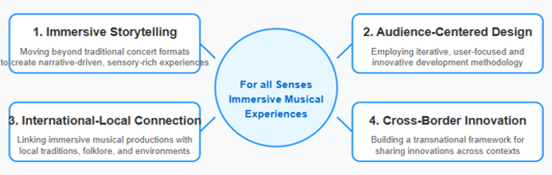 Figure 2: Diagram showing key elements to support the creation of new immersive musical experiences (by Laura Päiviö-Häkämies).
The Value of the application process
We don’t know the outcome of the application yet. The process from joint innovation to writing proved remarkably enriching. Defining the challenge and developing solutions together resembled a form of preparatory research in its depth and scope. Partners invested significant time and expertise in the planning process, demonstrating genuine commitment to shared goals. This experience illustrates how powerful networks can emerge during application phases—connections built on authentic collaboration rather than predetermined outcomes.
For cultural professionals considering similar applications, we recommend approaching the process as an investment in organizational development and network building, not solely as a funding strategy. The discipline of articulating innovations clearly, the relationships built through genuine collaboration, and the strategic insights gained through thorough research provide returns that extend far beyond any single project’s timeline.
For institutions like HUMAK, serving as a facilitator and a bridge-builder represents a core mission. We bring students into contact with emerging innovations and connect diverse actors who can spark new ideas together. If this application succeeds, we will share the implementation process openly, allowing others to learn from both our successes and challenges. Regardless of the funding outcome, the collaborative thinking and relationships forged during this process already contribute valuable insights to European cultural innovation.
Read more:
Antikainen, R., Kangas, H.-L., Alhola, K., Stenvall, J., Leponiemi, U., Pekkola, E., Rannisto, P.-H., & Poskela, J. (2019). Experimentation culture in Finland – present situation and development needs. In Kokeilukulttuuri Suomessa – nykytilanne ja kehittämistarpeet. Publications of the Government’s analysis, assessment and research activities 2/2019. Retrieved October 1, 2025, from https://julkaisut.valtioneuvosto.fi/handle/10024/161281
Sitra. (n.d.). Experiments as producers of societal data. The Finnish Innovation Fund Sitra. Retrieved October 1, 2025, from https://www.sitra.fi/en/blogs/experiments-producers-societal-data/
Baltic Sea Cultural Centre. (n.d.). Immersive storytelling and other projects. Retrieved October 1, 2025, from https://www.nck.org.pl/en
Humak University of Applied Sciences. (n.d.). International projects. Retrieved October 1, 2025, from https://www.humak.fi/en/innovation-service/projects/
Mahler Chamber Orchestra. (n.d.). Projects and innovative concepts. Retrieved October 1, 2025, from https://mahlerchamber.com/
Kalkun, M. (n.d.). Homepage. Retrieved October 1, 2025, from https://www.marikalkun.com/homepage
Music Export Ukraine. (n.d.). About us. Retrieved October 1, 2025, from https://www.musicexportukraine.com/
Tartu 2024. (n.d.). European Capital of Culture – insights and programme. Retrieved October 1, 2025, from https://tartu2024.ee/en
Turku Music Festival. (n.d.). Innovative concert formats. Retrieved October 1, 2025, from https://turunmusiikkijuhlat.fi/
Author:
Laura Päiviö-Häkämies, Principal Lecturer, Humak University of Applied Sciences.
PhD (European History), University of Helsinki
Published:
October 13th, 2025
Publications (Articles, Blogs & Podcast)
- Article

- Creative Field Entrepreneurship
The Window to India Is Open: Why Focused Strategy Defines the Next Breakthrough in the World’s Fastest-Growing Music Ecosystem
- Article

- Research and Development
- Resilient Societies
Crises as Catalysts for Change: The Foundations of the Resilient Societies Research Programme
- Web publication

- NGO Work
Ever Wanted to Be an Explorer? – Tikkala Schoolchildren Learning at the Struve Geodetic Arc at Oravivuori Station Point
- Web publication