From Instructor to Co-Creator: Participatory Pedagogy in Community Education
“Tell me and I forget. Teach me and I remember. Involve me and I learn.” ~ B. Franklin
Close your eyes and imagine a learning situation. Wherever you are, picture a moment that takes place in a school, a university, or even in a hobby. Many of us imagine learning as a situation where there is a teacher or instructor who provides rules, instructions, guidance, and support. At the same time, there are participants who are waiting for instructions and are ready to learn.
I have worked in the field of education for over twenty years, and I can confirm that many learning situations are often structured in this way. I have witnessed and been involved in similar situations countless times, both as a learner and as a teacher.
However, when we consider everything we know about effective, motivating, and enjoyable ways of teaching and more importantly about how people actually learn, we may begin to question whether this type of instruction should remain the dominant model in every learning environment.
From a broader perspective, this type of instructor-led learning is also relatively recent in human history. Schools, as we know them today, are a modern institution. For hundreds of thousands of years before that, humans learned in very different ways. Evidence from hunter-gatherer cultures suggests that children learned the skills they needed for adulthood through play, exploration, and participation in everyday life. Adults allowed children a high degree of freedom because they recognized these activities as natural and effective ways of learning (Gray, 2008).
Returning to the more familiar image of a classroom, where the teacher stands in front of the group explaining what to do, how to do it, and why, learning can easily become a series of tasks to complete rather than meaningful experiences. This is not necessarily a sign of effective learning. Participation also varies: some students engage actively, while others remain passive.
These common situations raise an important question:
How should the role of the instructor change in order to support participation and agency in community education?
Traditional instructor-led models, where the educator plans, leads, and evaluates, are not always sufficient to meet the needs of today’s learners. Current pedagogical knowledge about how learning happens, combined with contemporary challenges such as wellbeing, inclusion, and the development of agency, calls for a shift in how learning is designed and facilitated.
As we have seen from both human history and pedagogical practices — particularly in early childhood education — learners can be understood as active agents who learn through play, exploration, and interaction. These approaches have been shown to be effective in supporting both learning and motivation.
As learners grow older, educational practices often shift toward more controlled and instruction-driven approaches, which may gradually reduce opportunities for learner agency. This observation invites reflection on how teaching and learning environments could better support active participation throughout the educational journey. This perspective is especially relevant in the field of community education, where participation, inclusion, and agency are central elements of professional practices. Community educators often work in environments that require not only instruction, but also the ability to create meaningful participation, strengthen belonging, and support individuals and groups in becoming active members of society.
This article argues that participatory pedagogy offers community educators a framework for moving beyond activity-based instruction toward more collaborative and empowering forms of learning.
Participatory Pedagogy – A Theoretical Lens
Participatory pedagogy is not necessarily a completely new idea, nor is it overly complex. At its core, it can be summarized through a simple but powerful principle:
Participatory pedagogy aims to enable learners to be involved as active and empowered agents at every stage of the learning process (Flewitt et al., 2018).
In this approach, learners are not passive recipients of knowledge, but active participants in the learning process.
My own professional background in early childhood education has provided many opportunities to apply participatory pedagogical methods in practice. As a preschool teacher, I was expected to follow the national curriculum for early childhood education and care. However, I rarely planned monthly, weekly, or daily activities alone. Instead, I actively involved the children in planning what kinds of projects they were interested in.
For example, I used and further developed practices such as “children’s meetings,” where children were encouraged not only to take part in planning upcoming activities, but also to reflect on and evaluate what we had done and what they had learned. Often, the children themselves came up with the most meaningful ideas—such as where to go on a trip or which phenomena to explore. In these situations, my role shifted from being a traditional teacher to acting more as a facilitator and guide.
Of course, it is important to recognize that working in early childhood education differs from working in schools, youth work, or higher education. However, many of the core principles of participatory pedagogy—such as agency, shared responsibility, and meaningful engagement—can be applied across a wide range of learning contexts.
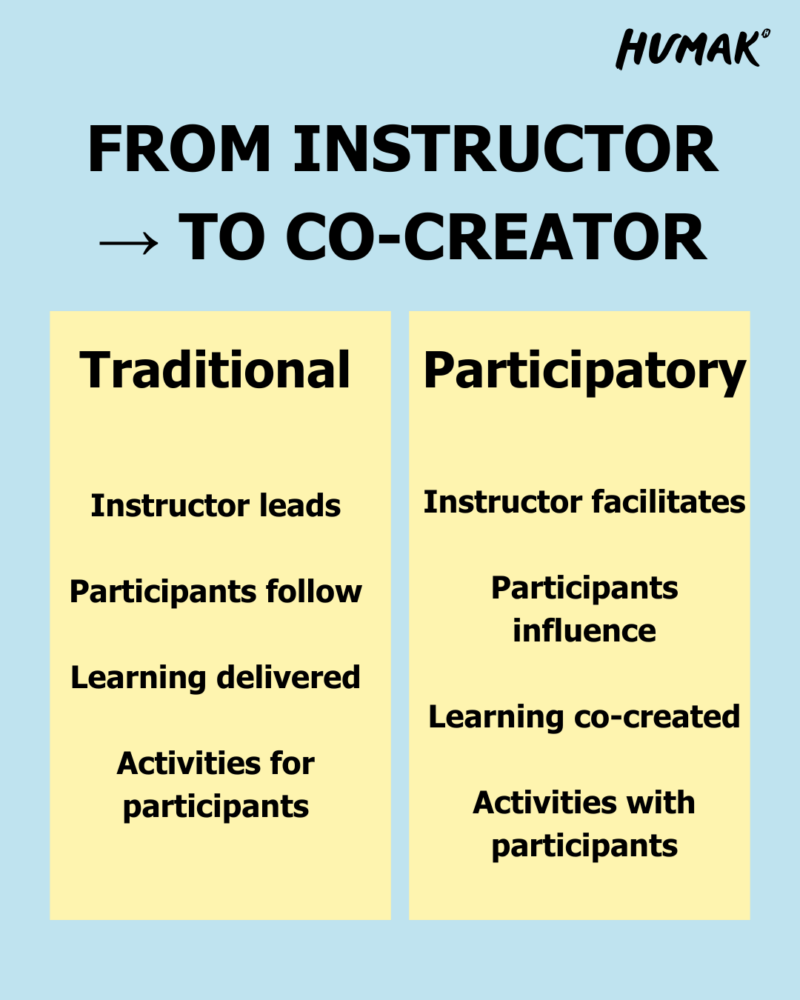
In a participatory pedagogical approach:
- Learning is co-created, not simply delivered
- Learners have agency and voice
- Responsibility is shared between the instructor and participants
Participatory pedagogy shifts the focus from transmitting content to creating conditions where learners can actively shape their own learning.
At the same time, participation itself is a complex and dynamic phenomenon (Sinclair, 2004). This is also illustrated in one of the most well-known frameworks for understanding participation, Hart’s Ladder of Participation (Hart, 1992), which describes different levels of participation and highlights how power and decision-making can be shared between adults and young people.
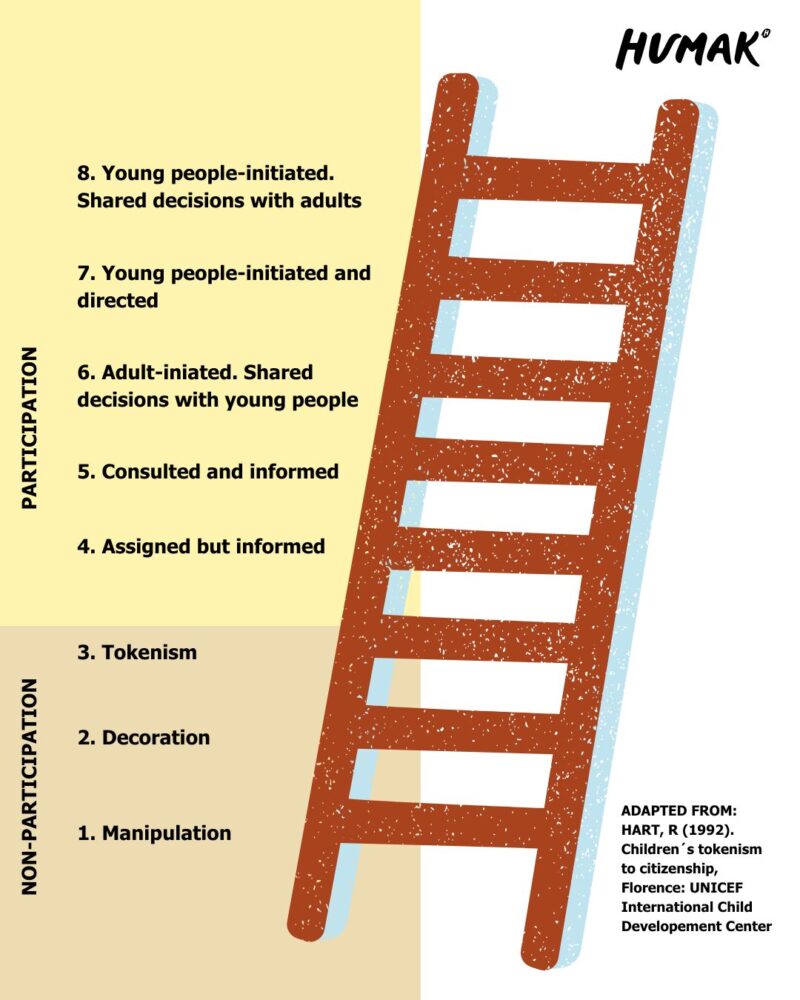
Source: Adapted and visually recreated by the author based on Hart (1992).
Hart´s Ladder of Participation also invites community educators to critically reflect on the quality of participation they create. Participation can range form tokenistic involvement to genuine shared decision-making, where participants are actively involved in shaping both activities and goals. For community educators, this means reflecting not only on whether participation truly exists, but also on how power and responsibility are shared within the learning process.
Rather than focusing solely on delivering knowledge, the instructor in a participatory approach creates opportunities for learners to influence the process, make decisions, and contribute to the direction of learning. This perspective aligns strongly with community education, where learning is often social, situational, and connected to real-life experiences.
The Instructor as Co-Creator
When participatory pedagogy is compared to more traditional approaches to teaching and instruction, the role of the instructor needs to change fundamentally. This shift has been widely discussed in educational theory, particularly in critiques of traditional teacher-centered approaches that position learners as passive recipients of knowledge (Freire, 1970).
In my own work as an early childhood educator, I consciously avoided positioning myself as an all-knowing authority. Instead, I found meaning in working and exploring together with the children. As mentioned earlier, I did not take full responsibility for planning activities alone. Rather, I focused on creating a framework within which the content could be co-created with the children.
There were also many situations where children asked questions to which I already knew the answer. However, instead of providing direct answers, I aimed to maintain their curiosity and support their problem-solving skills, creativity, and critical thinking.
For example:
“Olli, where does the world come from?”
“Olli, which is more valuable, water or humans?”
These kinds of questions reflect children’s natural curiosity and their desire to understand the world. If the educator simply provides an answer without involving the children in the thinking process, that curiosity may diminish.
In participatory pedagogy, the instructor is no longer primarily a controller of the process, but becomes:
Co-designer
–planning learning experiences with, not only for, participants.In this perspective, learning is understood as a social and interactive process, where knowledge is constructed through dialogue and shared activity (Vygotsky, 1978).
Listener
– observing and adapting to the needs of the group.The role of the instructor as a listener involves observing and responding to the needs of the group, adapting the level of support and guidance accordingly (Vygotsky, 1978; Black & Wiliam, 1998).
Negotiator
– balancing structure and freedom.Effective instruction requires a balance between guidance and autonomy, where the instructor provides structure while allowing learners meaningful opportunities to influence the process (Dewey, 1938; Biesta, 2013).
Enabler of agency
– creating space for decision-making and participation. Supporting learners’ agency is also closely connected to motivation, as autonomy and a sense of influence are key factors in meaningful engagement (Deci & Ryan, 2000).
Source: Created by the author.
This shift requires a different kind of expertise than simply managing a group or delivering ready-made plans. The instructor’s expertise is no longer measured by control, but by the ability to create space for meaningful participation. As Biesta (2013) argues, the role of education is not only to transmit knowledge, but to support individuals in becoming active subjects who can act and make decisions in the world.
The focus of pedagogy shifts from what the instructor does to what the participants are able to do, experience, and influence.
Designing Participation in Community Education
A graduate of the Community Educator degree is familiar with the factors that influence individual growth, development, participation, and well-being. They are also able to understand the underlying causes of social problems and identify opportunities for preventive work, particularly in contexts involving young people. Community educator training provides competencies for a wide range of professional tasks, including working with young people in diverse environments, engaging in professional organizational work and developing volunteer activities, as well as contributing to community work and the development of practices and methods. In addition, it prepares graduates for multidisciplinary collaboration, the promotion of network-based approaches, and various development tasks within professional communities (Studyinfo, n.d.).
The idea of community-based pedagogy has gradually developed and evolved in its own direction during the 2000s. Activity-based learning, experiential approaches, and a sense of community have long been at the core of community educator training (Kuivakangas, 2012).
However, activity-based learning, experiences, or a sense of community alone do not guarantee participation. Activities can be engaging, well-structured, and enjoyable, while still remaining instructor-led and leaving participants in a passive role. Even well-designed experiential approaches do not automatically ensure participation or the development of learner agency.
Participatory pedagogy challenges community educators to go one step further by asking critical questions:
- Who designs the activity?
- Who makes decisions?
- Whose voice is heard?
In practice, this may involve actively including participants—children, young people, and communities—in the planning and design of activities. During the implementation phase, instructors should encourage participants to take part in decision-making processes. Furthermore, instructors should aim to create safe spaces for dialogue and reflection, rather than relying solely on instructor-led discussions.
In participatory pedagogy, participation is not only about taking part in activities. It involves engagement in the entire process of learning, including planning, implementation, and evaluation.
Participation as Wellbeing and Inclusion
According to recent research, there is a clear link between students’ participation, recognition, and wellbeing at school. A study conducted in Australia, in which student participation was measured using a validated multidimensional scale, found that participation was strongly and positively associated with wellbeing (Anderson et al., 2022). Importantly, the study also showed that simply having a “voice” was not enough to predict wellbeing; rather, more authentic forms of participation—where students are genuinely involved in the process—were significantly related to higher levels of wellbeing.
What this research highlights is that participation is not only a pedagogical method—it is closely connected to wellbeing. Self-Determination Theory suggests that feeling heard, valued, and able to influence one’s environment supports motivation, a sense of belonging, confidence, and agency (Deci & Ryan, 2000). In other words, the more individuals feel appreciated and capable of influencing their environment, the more willing they are to participate. This creates a positive cycle that further strengthens wellbeing.
In community education, these elements are especially important. Learners come from diverse backgrounds and have different levels of confidence, experience, and readiness to participate. When participation is intentionally supported, learning environments become more inclusive, supportive, and meaningful.
Source: Canva Pro image, adapted by the author.
Participation is therefore not only about learning more effectively—it is also about fulfilling a fundamental human need: the need to belong.
Challenges and Tensions
While participatory pedagogy offers many benefits, it is equally important to recognize the challenges and tensions it may bring. As discussed earlier, it requires a fundamental shift in the role of the instructor. This shift demands a new kind of pedagogical mindset, as well as increased time, flexibility, and responsiveness.
In a participatory approach, the instructor must accept that not all aspects of the learning process can be fully controlled. Learning situations may develop in unexpected directions, and the instructor needs to be comfortable working with uncertainty. This can be particularly challenging in fields such as outdoor and adventure education, where participant safety is always a priority. In such contexts, it is essential to recognize that participation cannot always be maximized in every situation. Professional instructors must be able to judge when, how, and to what extent participation is appropriate.
Furthermore, learning groups are always composed of individuals with different backgrounds, abilities, and levels of confidence. Especially in the early stages of group formation, not all participants are immediately ready to take initiative or responsibility. Participation therefore needs to be built gradually. Without careful guidance, there is a risk of losing structure or direction.
This highlights an important point:
Participation does not mean the absence of structure, but the intentional sharing of control.
The instructor continues to play a crucial role in ensuring safety, direction, and purpose, but does so in a more flexible and responsive way. Participatory pedagogy does not reduce the demands placed on the instructor — on the contrary, it requires a higher level of awareness, adaptability, and professional judgment.
Conclusion – Towards Co-Created Learning
Since the early days of humankind, our ability to learn, adapt, and be creative has enabled us to survive and develop. Throughout history, humans have learned in many ways—through doing, through social interaction, through play, and through exploration. At the same time, our growing understanding of the human brain and pedagogical approaches has led to the development of a wide range of learning theories.
Alongside this evolution of learning, the role of the instructor has also changed. Today, it is increasingly clear that being a good instructor means something more than leading from the front. A good instructor can be understood as a designer of learning experiences, a facilitator of participation, and a builder of safe and inclusive learning environments.
These perspectives are especially important as the role of communities and community education continues to evolve. Individuals within communities need opportunities for social and active learning, where tasks and responsibilities are shared and negotiated. At its core, participatory pedagogy is about trust—trusting that participants can contribute, take responsibility, and shape their own learning.
The most effective educators may not be those who hold all the knowledge or provide all the right answers. Instead, their strength lies in how they create spaces where participants can be active, motivated, and engaged—spaces where learners can reflect, learn, and experience a sense of belonging.
This article argues that participation should not be understood merely as engagement in activities, but as meaningful involvement in the entire learning process.
Sources:
Anderson, D. L., Graham, A. P., Simmons, C., & Thomas, N. P. (2022). Positive links between student participation, recognition and wellbeing at school. International Journal of Educational Research, 111, 101896.
Biesta, G. (2013). The beautiful risk of education. Routledge.
Black, P., & Wiliam, D. (1998). Assessment and classroom learning. Assessment in Education, 5(1), 7–74.
Dewey, J. (1938). Experience and education. Macmillan.
Gray, P. (2008). A brief history of education. Psychology today.
Flewitt, R., Jones, P., Potter, J., Domingo, M., Collins, P., Munday, E., & Stenning, K. (2018). “I enjoyed it because … you could do whatever you wanted and be creative”: Three principles for participatory research and pedagogy. International Journal of Research & Method in Education, 41(4), 372–386. https://doi.org/10.1080/1743727X.2017.1405928
Freire, P. (1970). Pedagogy of the oppressed. Continuum.
Hart, R. A. (1992). Children’s participation in planning and design. Space for Children, The Built Environment and Child Development, Plenum Press, New York, 217-239.
Kuivakangas, J. (2012). Yhteisöpedagogiikan uudet avaukset. Humanistinen ammattikorkeakoulu. Vygotsky, L. S. (1978). Mind in society: The development of higher psychological processes. Harvard University Press.
Studyinfo. (n.d.). Community educator degree programme description. Retrieved from Yhteisöpedagogi (AMK) – Opintopolku
Writer: