When Mathematics, Art and Nature Meet
Art-based methods in the natural sciences integrate knowledge, emotions, and action. When mathematics, chemistry, or biology are learned in nature together with communities, using creative and artistic processes, learning becomes experiential and meaningful.
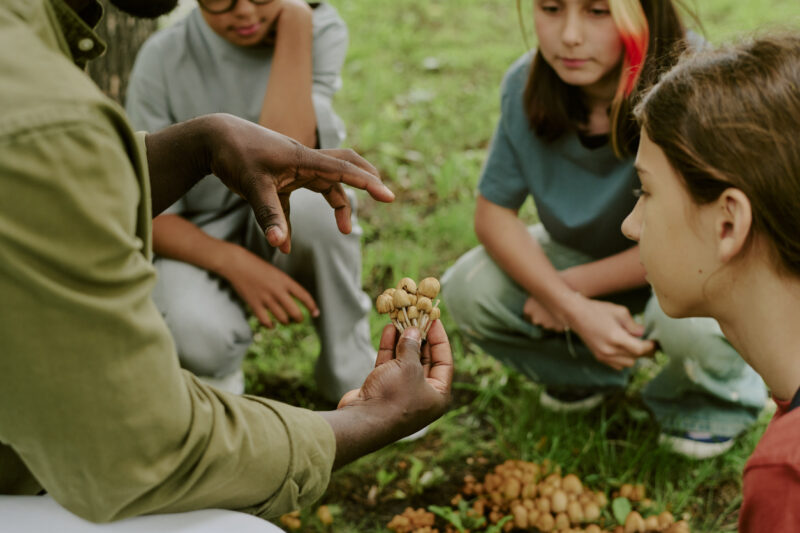
Art-based methods in the natural sciences integrate knowledge, emotions, and action. When mathematics, chemistry, or biology are learned in nature together with communities, using creative and artistic processes, learning becomes experiential and meaningful. This approach strengthens both the understanding of scientific phenomena and the ability to think creatively and critically.
Imagine a lesson where students are not sitting in a classroom calculating geometric formulas, but instead building an artwork in the forest from branches and stones. They measure, explore symmetry and shapes, while at the same time feeling the texture of the wood in their hands, smelling the scent of the forest and watching how their creation changes with the light.
Or imagine a chemistry class where students study pH levels by creating colour pigments from natural materials and documenting the changes artistically. In biology, they might take part in an ecological restoration project where scientific observation and artistic documentation go hand in hand.
This approach doesn’t just make learning more enjoyable — it also deepens students’ understanding of the world and helps them find meaning in their learning experiences.
 Istock.
Communities and Shared Creation
When students work together on creative and scientific challenges, they develop problem-solving skills, confidence in their own abilities and the capacity to collaborate with others. Art and culture offer ways to process emotions, express experiences and create meaning. They strengthen a sense of belonging and open space for reflection.
Community-based learning brings local knowledge and culture into the school. When learning moves beyond the classroom walls and into collaboration with local actors, it gains a whole new dimension. Students see how what they learn connects to real life and to their own environment. At the same time, it builds a sense of togetherness and strengthens bonds across generations
Science Needs Artistic Thinking
We live in a time when the importance of science in societal decision-making and in addressing global challenges has become increasingly evident—from climate change to pandemic responses and technological development. At the same time, however, trust in science has eroded in many places. Disinformation and fake news spread rapidly. How can we educate young people who understand the value of science, yet are also able to think creatively and critically?
When art and science meet, something unique emerges. Art makes abstract concepts concrete, sparks questions and encourages experimentation. It strengthens creative thinking — a skill essential for facing future challenges. At the same time, it brings playfulness and room for experimentation into learning, where mistakes are part of the process rather than failures.
This kind of learning also strengthens eco-cultural understanding — the ability to recognise the deep connections between humans and nature. It supports the sustainability transition by nurturing young people who can act both locally and globally in the face of a changing world.
Sources:
Kuo, M., Browning, M., & Penner, M. (2018). Do lessons in nature boost subsequent classroom engagement? Refueling students in flight. Frontiers in Psychology, 8, 2253. https://doi.org/10.3389/fpsyg.2017.02253
Nathan, M. J., Schenck, K., Vinsonhaler, R., Michaelis, J. E., Swart, M. I., & Walkington, C. (2024). Research avenues supporting embodied cognition in learning and instruction. Educational Psychology Review, 36(1), 10. https://doi.org/10.1007/s10648-024-09847-4
Skulmowski, A., & Rey, G. D. (2018). Embodied learning: introducing a taxonomy based on bodily engagement and task integration. Cognitive Research: Principles and Implications, 3, 6. https://doi.org/10.1186/s41235-018-0092-9
Author:
Nina Luostarinen, RDI Senior Specialist, Humak University of Applied Sciences, ORCID 0000-0003-0777-2858
Publication date: 16.12.2025
Publication series: Humak Harticle
Publisher: Humak University of Applied Sciences
Publications (Articles, Blogs & Podcast)
- Article

- Creative Field Entrepreneurship
The Window to India Is Open: Why Focused Strategy Defines the Next Breakthrough in the World’s Fastest-Growing Music Ecosystem
- Article
- Research and Development
- Resilient Societies
Crises as Catalysts for Change: The Foundations of the Resilient Societies Research Programme
- Web publication

- NGO Work
Ever Wanted to Be an Explorer? – Tikkala Schoolchildren Learning at the Struve Geodetic Arc at Oravivuori Station Point
- Web publication