

Sign language interpreting
Interpreter (Bachelor’s Degree)
Joint Application for Finnish-taught degree programmes
From 10.3.2026 at 8:00 to 24.3.2026 at 15.00
Please note that admission to these programmes requires B1 level Finnish proficiency.
The next application round for English-taught degrees is in January 2027.
Bachelor’s Degrees (in Finnish)
Master’s Degrees (in Finnish)
Be inspired, get passionate and make an impact – come study as a sign language interpreter!
The Interpreter (Bachelor’s degree), Sign Language Interpreting education will give you the skills necessary to work as a professional in sign language interpreting and linguistic accessibility. You will help everyone have their voice heard and understood.
Sign language and interpreting are mainly studied in the form of contact learning in Helsinki, in the Light House, which is known as the centre of sign language organisations. The common studies of the universities of applied sciences are mostly carried out online and independently.
The internships take you directly to the heart of the sign language community, where you can develop your professional skills in a variety of practical situations. We are the only educational institution in Finland that also trains deaf interpreters and interpreters for Finnish Swedish sign language.
Who is this programme for?
People interested in sign language
You may have witnessed sign language or have occasionally studied the basics of sign language and the alphabet. Perhaps you have wondered how great it would be to be able to use sign language. Now is the time to make your dreams come true!
Those interested in multiculturalism and encounters between people
The sign language community is multicultural and diverse. As a sign language interpreter, you will encounter clients of different ages and understand linguistic, cultural and identity diversity in different environments. If you are fascinated by meeting people and learning new things, you have come to the right place!
Those who want to do meaningful, impactful work
Working in the field of sign language is meaningful and impactful. Each interpreted interaction situation promotes equality and inclusion– you help people meet, remove barriers and build bridges between different languages and cultures. If you want to make an impact on society, come and study sign language interpreting!
People seeking and supplementing their career path
Are you looking for a new direction in your career and want to find a place where you can use sign language? You can develop your career path based on your interests and previous skills in, for example, NGOs, the public sector or business. If you are not sure whether you want to become an interpreter, but you want sign language to be part of your life and influence equality in society, this education is a great stepping stone to working life. You can promote accessibility and the rights of people using sign language.
Programme content
The degree programme consists of common studies at the university of applied sciences, sign language and interpreting studies, internships as well as advanced studies.
The Interpreter (bachelor’s degree), Sign Language Interpreting degree programme includes 240 credits, and it usually takes 4 years to complete. The study time can be reduced by a Recognition of Prior Learning (RPL) and/or summer studies.
Common studies provide you with the readiness to study, perform well in working life and develop your skills. Ethics, internationality and cultural diversity form the basis of sign language interpreting and support the development of your expertise.
Sign language interpreting courses are taught throughout the course. Teaching takes place mainly in the form of contact learning on the Helsinki campus, in the Light House. You will learn sign language together with your classmates in face-to-face interaction under the guidance of sign language senior lecturers. You will mainly study Finnish Sign Language, but you can also study Finnish Swedish Sign Language if you wish.
Your sign language skills develop step by step – from learner to master.
Interpreting in sign language courses focuses on interpreting in a variety of ways. You will learn the basics of interpreting, the background and theories of interpreting, and learn interpreting in practice. Most of the education takes place in a classroom setting on the Helsinki campus, in the Light House, where senior lecturers will guide you in groups as well as personally.
Step by step, you go from learner to expert and deepen your skills in interpreting not only during lessons but also in real interactive situations.
In sign language interpreting courses, you will deepen your professional skills in the area that interests you. You can choose one of the following as your advanced studies: Interpreting for the Deaf-Blind, Speech-to-Text Interpreting, Developing Linguistic Accessibility or Developing Pedagogical Skills. In addition to advanced studies, there are also optional courses, with which you can tailor your studies according to your goals and interests.
Your studies will include 30 credits worth of internships, which will bring you into the real world of the sign language community. In the initial phase, you will get to know the community and the interpreting industry, and in the later stages you will be able to interpret in real interactive situations. The training is multifaceted and takes place in educational institutions, with deaf immigrants, in the theatre and in interpreting companies.
During the internships, you get to network with working life during your studies and create valuable contacts with industry players. Networks and work experience acquired through traineeships often play an important role in employment.
At Humak, the RPL, i.e. Recognition of Prior Learning procedure, means in practice that a student can make use of their prior expertise to advance their studies. This expertise can come from work experience, prior studies or, for example, hobbies and volunteer work, if they are related to the goals of the studies. Approved skills are entered into the study register, which can compensate for a course partially or entirely. Your personal coach is responsible for the RPL procedure.
We also offer you the opportunity to complete courses as summer studies.
Who are the daytime studies suitable for?
Helsinki
Daytime studies are perfect for you, if…
You study with a sign language community
Studies in sign language interpreting take place on the Helsinki campus at the Light House, where several hearing organisations also operate. In this unique environment, you will see sign language in everyday life, and during your studies you will be able to get to know other organisations in the field and interpreters.
You learn best in a group
In daytime studies, you progress with your group of students at the same pace and according to a mutually agreed timetable. The community and interaction on campus will support your learning, and you will be supported by coaching and the social support of the study group.
You benefit from a clear study structure
In daytime studies, you study weekly on campus and also online. Regularity and a clear structure will help you to establish a study routine. As your studies progress, you will have more room for independent work.
What skills will you have upon graduation?
Our goal is, that upon graduation, you know how to…
Finnish Sign Language
You possess Finnish Sign Language skills in accordance with the general Finnish language proficiency scale (YKI) at a proficiency level of 4 (European reference framework B2). At this level, you will be able to cope independently in a variety of situations, and you will be able to discuss both concrete and abstract topics. You have studied Finnish or Finnish-Swedish Sign Language
Interpret smoothly
You can interpret in a variety of interactive situations and environments. Depending on the client and the situation, you can interpret either between a spoken and a sign language or between two sign languages. You recognise differences between cultures. By your actions, you enable smooth communication between the various parties.
Act ethically
You can apply the interpreter’s code of ethics in practical situations and make ethically sustainable solutions. You understand the significance of confidentiality and impartiality.
Promote equality
You understand and recognise the position of minorities in society and promote the realisation of their social and linguistic rights. You have studied the history of Finnish Sign Language.

“If you’re interested in meeting people from different backgrounds, communication, linguistic accessibility and learning a new language, this programme could be perfect for you!”
Outi Kuvaja, lecturer (Interpreter, Bachelor’s degree)
The landscape of a sign language interpreter – diverse, colourful and fascinating!
As a sign language interpreter, you have a unique vantage point for all areas of life. Your work ranges from school to workplaces, from cultural events to healthcare and from organisational activities to everyday encounters. You will have the opportunity to see and influence how achievable communication connects people, breaks down barriers and builds bridges between languages and cultures.
As an expert in linguistic accessibility, you can use your experience and educational background in many different fields, such as in the public sector, non-governmental organisations, companies, and the culture and media sector. Sign language interpretation education provides multifaceted capacities to influence and promote equality, making the world a more accessible place for everyone.
Check the vlog, Tulkeista on moneksi (It takes all kinds to be an interpreter):
Frequently asked questions
No, it is not. Finland also has two sign languages: Finnish Sign Language and Finnish Swedish Sign Language
No, you do not need to know it in advance. Sign language studies are started from the basics, so no prior experience is required. If you already have a level of proficiency in a sign language – more or less – you have the opportunity to take part in courses (RPL) and progress more quickly.
No, you cannot. Although some courses are online and studied independently at home, the majority of sign language and interpreting courses involve contact teaching at the Helsinki campus, the Light House. Contact teaching enables the learning of sign language in a natural interaction with the teacher and other students. You will receive immediate feedback on interpretation and the use of sign language, and you will be able to practise facial expressions, gestures and eye contact – all key sign language skills. Group and pair exercises provide effective support for learning and make learning diverse and stimulating.
It is possible to combine work and study, but it requires planning and the energy to stick to a plan. Teaching is usually held on business days between 8 am and 4 pm.
No, interpreters are not aides. An interpreter is an impartial facilitator of communication whose role is to support the client’s autonomy and inclusion and linguistic accessibility.
Interpreters work in a wide range of settings, from prenatal clinics to estate inventories. Working environments can include a doctor’s office, a high school, a hockey hall, a TV studio, a maternity ward, …
Although the degree programme language is Finnish, some courses can also be taken in Swedish. So it is worthwhile, and often possible, to practice interpreting in your mother tongue. You can write your homework in Swedish, as well as your thesis. The aim is to provide those who wish to study Finnish Swedish Sign Language with regular opportunities to do so.
Further information
Apply via StudyInfo!
Tutkintoon voi hakea seuraavan kerran kevään toisessa yhteishaussa 10.3.2026 klo 8.00 – 24.3.2026 klo 15:00.
Want to know more?
Download our digital brochure (in Finnish) and find out more about Humak and our degrees!
Need help?
Our admission services are here for you!
You can contact us by email or phone.
The contact information opens from this link.
Related degrees
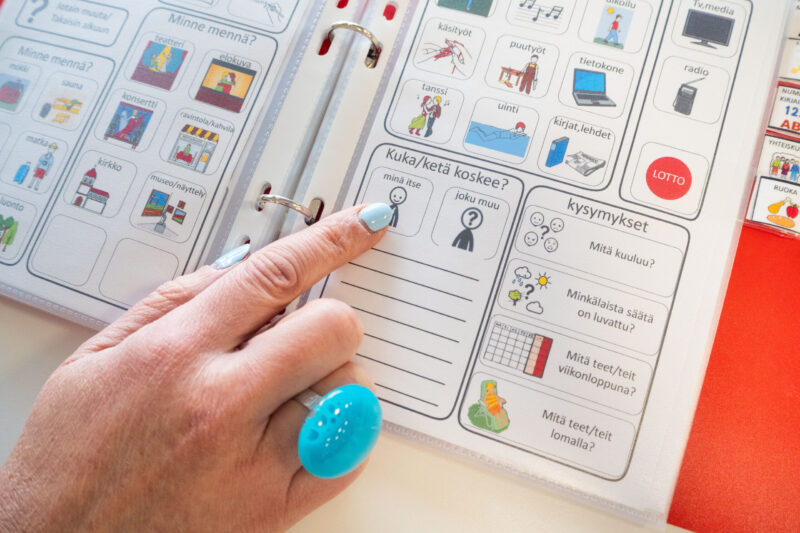
Interpreter (Bachelor’s Degree), Interpreting and AAC instruction
Blended studies
Kuopio | Tampere

Interpreter (Master’s degree), Interpretation Development
Online studies (in Finnish)

European Master in Sign Language Interpreting
(EUMASLI)
Blended studies
Helsinki, Scotland, Germany