
Humak’s Ethical Guidelines
1 ETHICAL ACTIVITIES AT HUMAK
The ethical principles and guidelines of Humak University of Applied Sciences are based on Humak’s values: communality, responsibility, equality, and humanity. These values guide all members of our higher education community to act responsibly and respectfully in all matters related to studying, work, and collaboration, both within Humak and with our external stakeholders. In addition to our values, Humak’s activities are guided by general ethical principles, supplemented by sector-specific ethical policies and guidelines on data protection and information security.
1.1 Ethical conduct in the higher education community
Humak’s activities aim for social impact. We create competence for society, develop solutions for building a more sustainable and fair world, and train the experts society needs. Impact requires ethical judgement and shared principles that each member of our community is committed to.
Humak’s personnel are committed to collaboration and fostering a positive work community. We follow the principles of good governance and are committed to open decision-making. We ensure physical and digital accessibility and report any shortcomings through our feedback channels. We respect each other’s free time.
Humak’s management is committed to promoting equality and non-discrimination and monitors progress towards these objectives. Every two years, Humak conducts an equality, non-discrimination and accessibility survey among its personnel and students. The results are used as the basis for drawing up Humak’s Equality, non-discrimination and accessibility plan.
We commit to sustainable development, environmental responsibility, and ethical decision-making in all our activities. We are committed to the Arene’s sustainability programme (2026), and the principles of the UN 2030 Agenda. Every member of our community is responsible for their own actions and their impacts. We aim to achieve a positive impact (handprint) far greater than our size, especially in promoting culture and social sustainability. We are constantly working to reduce our carbon footprint.
1.2 Principles of a safer space
Humak follows the principles of a safer space. Every student and member of personnel is treated fairly and equally, regardless of their ethnic background, gender, language, religion, political or other opinion, national or social origin, property, birth or other status. In a safer space, everyone helps build an equal, respectful, and open atmosphere through their own actions.
The safer space principles apply to the entire higher education community, and everyone is expected to commit to following them. The safer space guidelines are reviewed with students at the start of every course. Humak does not tolerate inappropriate treatment, harassment, discrimination, threats, or violence in any situation, and any violations are addressed immediately. Humak has an early support model and a model for intervening in bullying for students, which describe how to respond to different situations that cause concern or involve bullying or harassment, and who to contact. Humak’s personnel intranet also contains various safety and operating instructions for personnel.
2 ETHICAL GUIDELINES FOR STUDIES AND TEACHING
Humak is committed to ensuring a peaceful work and learning environment for its personnel and students. Personnel and students are expected to show mutual respect and work together to ensure a disturbance-free environment for all. Through their actions, Humak’s personnel and students strengthen an encouraging, open, and communal operating environment.
Humak complies with regulations on data protection and information security. Humak’s personnel adhere to professional ethics and research integrity. Humak’s personnel and students act responsibly on social media and across all forms of communication.
Students are responsible members of the Humak community and follow Humak’s values and ethical principles in all their activities, including studies, internships, research, development and innovation activities, and Humak’s cooperation networks. Each student is responsible for their own learning, study planning, and professional development. In group assignments, every student is responsible for their own actions and their group’s efforts and results. Students are responsible for the progress of their studies and can contact their PSP coach or Study Counsellor whenever necessary. They are expected to organise their schedules so that they can progress smoothly in their studies and participate in the teaching provided.
Humak’s Degree Regulations outline the principles and key instructions concerning studies and teaching, as well as each student’s rights and obligations. In addition, the Degree Regulations describe the review procedure and appeals, the disciplinary procedure laid down in the Universities of Applied Sciences Act, and the principles of the revocation and restoration of the right to study. More detailed instructions on the revocation and restoration of the right to study are provided in the document Instructions for Revoking and Restoring the Right to Study.
2.1 Ethical guidelines for theses
As part of its thesis process, Humak follows the Ethical Recommendations for Theses in Universities of Applied Sciences, issued by the Rectors’ Conference of Finnish Universities of Applied Sciences Arene. These recommendations are based on legislation and the principles and recommendations for research ethics in the Finnish scientific community. They are consistent with the Finnish National Board on Research Integrity’s (TENK) Code of Conduct for Research Integrity and Procedures for Handling Alleged Violations of Research Integrity in Finland (RI 2023), to which Humak is committed.
Humak’s ethical guidelines for theses are publicly available on Humak’s student webpages. When working on their thesis, students must act ethically and responsibly and, where appropriate, consider the principles of sustainable development and related ecological, economic, social, and cultural considerations. Students are expected to follow Humak’s source referencing guidelines when citing sources in their theses and publications. All theses at Humak are inspected using plagiarism detection software. Humak’s Data Protection Office provides instructions on matters related to the data protection and information security of theses.
2.2 Guidelines for the use of artificial intelligence
Humak adheres to the Recommendations on the Use of Artificial Intelligence for Universities of Applied Sciences, issued by the Rectors’ Conference of Finnish Universities of Applied Sciences Arene. Humak promotes the responsible use of artificial intelligence (AI) in all activities. Humak has developed its own AI strategy and issued guidelines for students and personnel on the use of AI in their studies and work. The student guidelines are available on Humak’s student webpages, while the personnel guidelines are available on Humak’s personnel intranet. Humak’s Thesis Guide contains instructions on the use of AI in thesis work.
Humak’s Canvas learning platform is set to adopt Arene’s traffic light model for the use of AI in learning assignments and theses. In addition, further instructions on the use of AI may be provided in courses, learning assignments, and theses. Any use of AI that violates the guidelines will be considered academic misconduct.
Humak recommends that its personnel and students use the AI programs and applications offered by Humak in their work and studies. When using any other AI programs or applications, the user is fully responsible for ensuring that their use is appropriate and compliant with all data protection requirements.
2.3 Academic misconduct
Ethics and responsibility are the cornerstones of Humak’s activities. Humak follows the principles and procedures of research integrity as described in the Finnish National Board on Research Integrity’s (TENK) Code of Conduct for Research Integrity and Procedures for Handling Alleged Violations of Research Integrity in Finland (RI 2023) in all studies, theses, and RDI activities. The basic principles of research integrity are reliability, honesty, respect, and responsibility.
Each student is responsible for acting honestly, and Humak ensures that students receive the support they need to learn the principles of research integrity. Humak monitors students’ compliance with research integrity and works to prevent academic misconduct.
Academic misconduct refers to dishonest actions, whether intentional or resulting from negligence, through which a student seeks to gain an advantage for themselves or another student in study-related performances. The provisions on academic misconduct in learning assignments also apply to theses.
Academic misconduct may include:
- Cheating in an exam, i.e. acting in a manner that violates examination instructions, such as having another person take the exam or taking the exam on behalf of another student, copying answers, or using unauthorised aids during an exam.
- Copying a learning assignment, having another person complete it, or completing it on behalf of another student.
- Copying another student’s learning assignment, exchanging assignments, or completing an individual assignment in a group.
- Fabrication, i.e. presenting false observations, data, results, or sources.
- Falsification, i.e. modifying or presenting original observations in a way that distorts the results based on those observations.
- Plagiarism, i.e. using the work or ideas of others without permission or proper citation.
- Using AI in a way that violates the instructions provided by the lecturer or Humak’s guidelines.
- Neglecting Humak’s instructions for internships.
Disregard for research integrity is also considered a violation of research integrity. Examples of such disregard in studies include not requesting or complying with the permits and statements required for studies or theses; inadequately documenting or storing research results and materials; inappropriately delaying or hindering the work of other authors; inadequately or inappropriately referencing previous research results; and minimising the contribution of other authors.
2.4 Handling suspected cases of academic misconduct
Detecting and investigating suspected misconduct
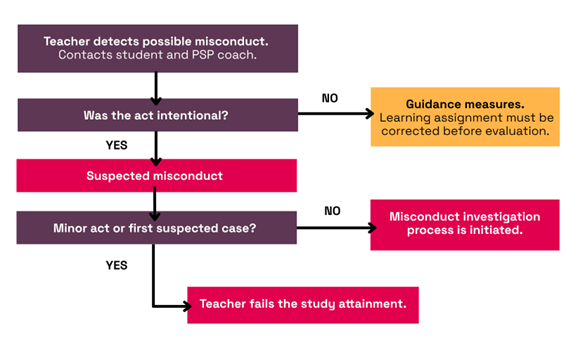
When a teacher detects a possible case of academic misconduct, they must contact the student and their PSP coach without delay to investigate the intentionality of the act, either by discussing it with the student or by asking them for a written explanation. If the student did not intentionally engage in misconduct, they will not, as a rule, be penalised for the error; instead, the teacher guides them to follow instructions and good practices. The student will also be required to amend the incorrectly completed learning assignment and the poor practices they engaged in before the evaluation of their study attainment. If the student knew or should have known that they were engaging in misconduct, the matter will be investigated as a suspected case of academic misconduct.
If the suspected act of academic misconduct can be considered minor and is the student’s first suspected case of misconduct, the teacher can fail the study attainment without initiating a more detailed misconduct investigation process. If the student does not provide an explanation for the misconduct within the reasonable deadline set by the teacher, if the student’s explanation is not sufficient, or if the student has previously been guilty of misconduct, a misconduct investigation process will be initiated. The student also has the right to request a misconduct investigation process if they wish to request a review of a study attainment that was failed due to a suspected case of academic misconduct.
Misconduct investigation process
If the investigation of a suspected case of misconduct progresses to the misconduct investigation process, either at the teacher’s or student’s initiative, the following procedure is followed:
- The teacher who detected the misconduct requests a written explanation from the student and reports the suspected misconduct to the Chief of Education.
- The Chief of Education arranges an opportunity for the student to be heard and may, if necessary, request additional information from the student, the teacher who reported the misconduct, or any other party involved. Before the hearing, the student must be told why they are being heard and the purpose of the hearing. The student hearing process is always conducted in writing.
- If the misconduct is considered minor, the Chief of Education decides on the disciplinary action, which can include retaking the failed study attainment or being issued a written reprimand. If the misconduct is serious or repeated, the Chief of Education prepares a proposal for the President of Humak on the disciplinary action to be taken.
- The President makes the decision and imposes the possible disciplinary action in accordance with the Universities of Applied Sciences Act (932/2014, section 38). Possible disciplinary actions include issuing a written warning or suspending the student for a fixed period. The decision to suspend a student for a fixed period is made by Humak’s Board of Directors on the President’s proposal.
2.5 Suspected academic misconduct in theses
Any suspected violations of research integrity (RI) in Bachelor’s or Master’s theses are handled through an internal process according to Humak’s own guidelines. If the suspected violation of research integrity concerns scientific research, of which the thesis is a part, the suspected violation is processed according to the RI process described in The Finnish code of conduct for research integrity and procedures for handling alleged violations of research integrity in Finland (RI 2023). The RI process applies to situations where, for example, a thesis supervisor is suspected of plagiarising a thesis in their own scientific publication. The President of Humak decides whether there is reason to initiate a preliminary inquiry under the RI process or whether the case is handled in Humak’s own internal misconduct investigation process.
If a thesis supervisor detects a possible violation of research integrity in a thesis, the following procedure is followed:
- The thesis supervisor requests a written explanation from the student. If the student did not intentionally engage in misconduct, the supervisor guides the student to follow research integrity. If the student knew or should have known that they were engaging in misconduct, the matter will be investigated as a violation of research integrity.
- The thesis supervisor reports the suspected violation of research integrity to the Chief of Education.
- The Chief of Education discusses the suspected violation with the President of Humak. The President decides whether to initiate a misconduct investigation process.
- When a thesis writer is suspected of academic misconduct, the Chief of Education hears the student and the thesis supervisor, as well as the commissioner of the thesis and other related actors, as necessary. The Chief of Education may appoint an impartial working group to investigate the possible violation.
If a thesis has already been published in Theseus and is subsequently found to contain plagiarism or other academic misconduct, the matter will be handled in accordance with Humak’s procedure either as academic misconduct (section 38 of the Universities of Applied Sciences Act) or, when necessary, as a suspected violation of research integrity in the RI process. If the misconduct is confirmed, the thesis can be removed from Theseus or marked as failed. The possible revocation of the related degree requires a separate decision to annul the relevant administrative decision.
3 ETHICAL GUIDELINES FOR RESEARCH, DEVELOPMENT AND INNOVATION ACTIVITIES
3.1 Research integrity in RDI activities
The principles of research integrity guide Humak’s research, development and innovation (RDI) activities, as well as the implementation of all related projects and research throughout their lifecycles. Humak is committed to the Finnish National Board on Research Integrity’s (TENK) Code of Conduct for Research Integrity and Procedures for Handling Alleged Violations of Research Integrity in Finland (RI 2023) in all its scientific, artistic, and other research activities.
Humak’s RDI activities follow the basic principles of research integrity, which include reliability, honesty, respect, and responsibility. All RDI actors and Humak’s management are responsible for complying with the principles of research integrity. All those involved in RDI activities must be familiar with the procedures of research integrity, be able to recognise the signs of violations of research integrity and know how to report any suspected violations.
The principles of research integrity are reflected throughout the process: ensuring the quality of RDI activities; open and fair planning, implementation, and reporting; valuing all those involved in RDI activities, as well as society and the environment; and taking responsibility at every stage of the project or research, from ideation to administration, supervision, implementation, publication, and assessment of impacts. Humak’s RDI activities comply with the recommendations of the Finnish National Board on Research Integrity TENK on the use of AI in research.
Humak is part of TENK’s network of research integrity advisers and a member organisation of the Human Sciences Ethics Committee of the Helsinki Region Universities of Applied Sciences. Everyone working and studying at Humak must adhere to research integrity and the ethical principles of research, as well as data protection regulations concerning the processing of personal data and the protection of privacy.
As a rule, any suspected violations of research integrity in Humak’s RDI projects will be handled in accordance with the RI process, as RDI projects are considered research activities within the scope of the RI guidelines. All suspected violations are always reported to the President, who decides whether to initiate a preliminary inquiry.
3.2 Principles of open science and research
Humak is committed to the Declaration for Open Science and Research 2025–2030. This means that Humak is committed to pursuing the Declaration’s vision of open science and research, implementing the Declaration’s commitments in its activities according to the principles of responsible openness, and promoting the objectives of the national openness policies supplementing the Declaration.
The principles that guide the promotion of open science and research – collaboration and participation, diversity and multilingualism, transparency and accountability, and sustainability and the common good – also guide Humak’s activities. Humak’s operating culture is based on openly sharing knowledge and expertise and developing new knowledge through networks. Humak invites key actors to participate in its RDI activities, and everyone is welcome to participate in the development process. Humak’s RDI activities promote multilingualism, as well as openness and accessibility, and they pay particular attention to the safety of all RDI actors, the needs of society, and responsible internationalisation. Humak’s RDI activities also take into account the UN Sustainable Development Goals and seek to facilitate openness in an economically sustainable manner while recognising that the benefits of research belong to everyone.
Through its commitment to the Declaration for Open Science and Research 2025–2030, Humak is dedicated to advancing openness in its operating culture, publishing, research methods and materials, and learning. Humak aims to promote openness across all its activities, making the knowledge and expertise it produces available to all. This commitment to openness will also develop the quality, reliability, and impact of Humak’s activities and drive new innovations.
REFERENCES
Universities of Applied Sciences Act, 932/2014.
Arene. (2018). Ethical recommendations for thesis writing at universities of applied sciences. ETHICAL RECOMMENDATIONS FOR THESIS WRITING AT UNIVERSITIES OF APPLIED SCIENCES.pdf (Accessed 18 August 2026)
Arene. (2026). Sustainability Programme for Universities of Applied Sciences 2026–2030. Sustainability-Programme-for-Universities-of-Applied-Sciences-2026–2030.pdf (Accessed 18 August 2026)
Arene. (2026). Arene’s recommendations on the use of artificial intelligence for universities of applied sciences. Arenes-recommendations-on-the-use-of-artificial-intelligence-for-universities-of-applied-sciences.pdf (Accessed 19 August 2026)
Arene. (2026). Arene’s recommendations on the use of artificial intelligence for universities of applied sciences. The Traffic Light Model. AI_The-Traffic-Light-Model_Arene.pdf (Accessed 21 August 2026)
Open Science Coordination in Finlanf and the Federation of Finnish Learned Societies. (2025). Declaration for open science and research 2025-2030. DECLARATION FOR OPEN SCIENCE AND RESEARCH 2025–2030. Responsible Research series 6:2025. Tieteellisten seurain valtuuskunta (Accessed 19 August 2026)
Metropolia. (2026). The Human Sciences Ethics Committee of the Helsinki Region Universities of Applied Sciences. Ethics Committee | Metropolia UAS. (Accessed 19 August 2026)
Finnish National Commission on Sustainable Development. (2026). Global 2030 Agenda for Sustainable Development. Agenda2030 | Sustainable Development. (Accessed 18 August 2026)
Federation of Finnish Learned Societies. (2026). What is open science. What is open science? | Open Science. (Accessed 19 August 2026)
Finnish National Board on Research Integrity (TENK). (2023). Finnish code of conduct for research integrity and procedures for handling alleged violations of research integrity in Finland 2023. The Finnish code of conduct for research integrity and procedures for handling alleged violations of research integrity in Finland 2023. (Accessed 12 May 2026)
Finnish National Board on Research Integrity (TENK) 2026. Research Integrity (RI). Research Integrity (RI) | Finnish National Board on Research Integrity TENK. (Accessed 18 August 2026)
Finnish National Board on Research Integrity (TENK). (2026). Artificial Intelligence in Research: Research Integrity and Ethical Principles. Recommendation of the Finnish National Board on Research Integrity TENK 2026. Artificial Intelligence in Research: Research Integrity and Ethical Principles. Recommendation by the Finnish National Board on Research Integrity TENK 2026 (Accessed 19 August 2026)