Sustainability and language
Last spring, a question was posed to the Humak staff in a survey: “What does responsibility mean to you?” The purpose of the survey was to prepare for Humak’s workplace community development days this August, as this year’s topic will be Responsibility and Sustainable Development.
Last spring, a question was posed to the Humak staff in a survey: “What does responsibility mean to you?” The purpose of the survey was to prepare for Humak’s workplace community development days this August, as this year’s topic will be Responsibility and Sustainable Development. However, the survey allowed us to answer the question with one or two words, only. Tough! How did or how would you define responsibility in two words?
In this blog text, I will take a look at responsibility and sustainability from a UAS lecturer’s and language teacher’s perspective and try to come up with my two-word definition for responsibility. The text is written in English because it will be used as teaching material in my English classes.
 A question from a staff survey: What does responsibility mean to you?
Sustainability and large language models
At the moment, both AI – or large language models – and sustainability are hot topics in society. They are also important elements in Humak’s new curricula – but are they compatible? It takes tremendous amounts of energy and natural resources when one employs AI, and, behind AI, there are hours and hours of work by cheap labour in the developing countries in questionable conditions. (Quite annoyingly, each Google search gives an AI summary these days – a reason good enough to start using another search engine!)
We, UAS lecturers, should teach our students to think, write and act in a sustainable way, and, simultaneously, help them become familiar with the modern everyone’s tool, AI. To me, it is a conundrum how to combine these two.
Sustainability and the Finnish language
Another question I keep thinking is the future of the Finnish language. Educational institutions have a responsibility to maintain the status of Finnish language in education, business and the Finnish society, in general. As English has become the lingua franca of the modern world, there is a risk of Finnish becoming a low-prestige language or “kitchen language” – kyökkikieli.
In an interview for Yle, Janne Saarikivi, linguist, former professor, and beloved essayist, is not worried about the natural changes taking place in our language, such as English words entering the Finnish language. What he is worried about, is universities changing the language of instruction into English. According to him, new English words heard at a skate ramp are quite a different story from teaching, studying, or, say, writing a final thesis in English. In an Op-Ed for Helsingin Sanomat, he asks, whether there might be a bit of inconsistency in a language policy where immigrants of lower social classes are expected to learn better Finnish while the educated overclass communicate in English.
If you have colleagues or students or friends who are not yet fluent in Finnish, there is an easy way to help them improve their language skills: speak and write Finnish to them. They probably want you to but are too polite to point it out. In the long run, it is a linguistically sustainable solution.
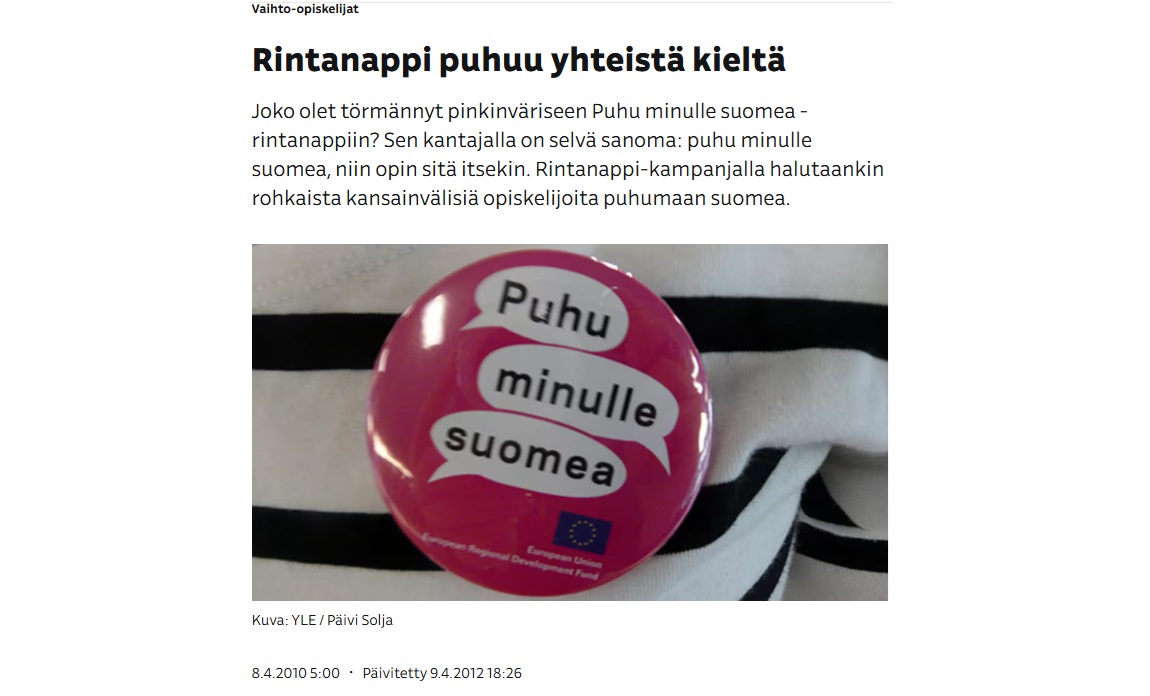 The badge of Puhu minulle suomea campaign from 15 years ago. https://yle.fi/a/3-5540400.
Cooperation with AI – questions rather than answers
To find my two-word definition for responsibility, I decided to throw a prompt – just a single one – at AI, but this time I did not pose questions to it or start discussing with it. Instead, I asked it to provide me with a list of questions to explore my own thoughts. ChatGPT gave me altogether eight questions. What would your answers to these questions be?
1. How do you see your role in shaping the intellectual and personal development of your students?
2. What values or skills do you most want your students to take away from your teaching?
3. How do you ensure that the information you share is accurate, up-to-date, and ethically presented?
4. Do you feel a responsibility in how you influence students’ thinking or worldview?
5. What do you see as your duties to your colleagues, institution, and academic field?
6. Does your field of teaching or research intersect with issues of environmental, social, or economic sustainability? If so, how?
7. What responsibility do you think universities and educators have in addressing the climate crisis or broader sustainability challenges?
8. Do you feel a duty to advocate for change within your institution or discipline regarding sustainability?
Shaping our students’ intellectual and personal development
The idea that we, as teachers, shape the intellectual and personal development of our students as well as the thought of students actually taking away bits and pieces from my teaching make me feel very responsible, indeed. How would I want to shape my students’ development? What would I want to give them?
Firstly, as a language teacher, I would like my students to learn to communicate in both domestic and international contexts in a responsible, friendly, culturally aware manner, using terminology that promotes sustainability.
Secondly, I would like them to become aware of the role of the English language as a global lingua franca as well as the relationships between the Finnish majority and the range of our domestic minorities – the Deaf, the Sámi, the Roma, the Karelians, the Swedish-speaking Finns – and, of course, the immigrant minorities.
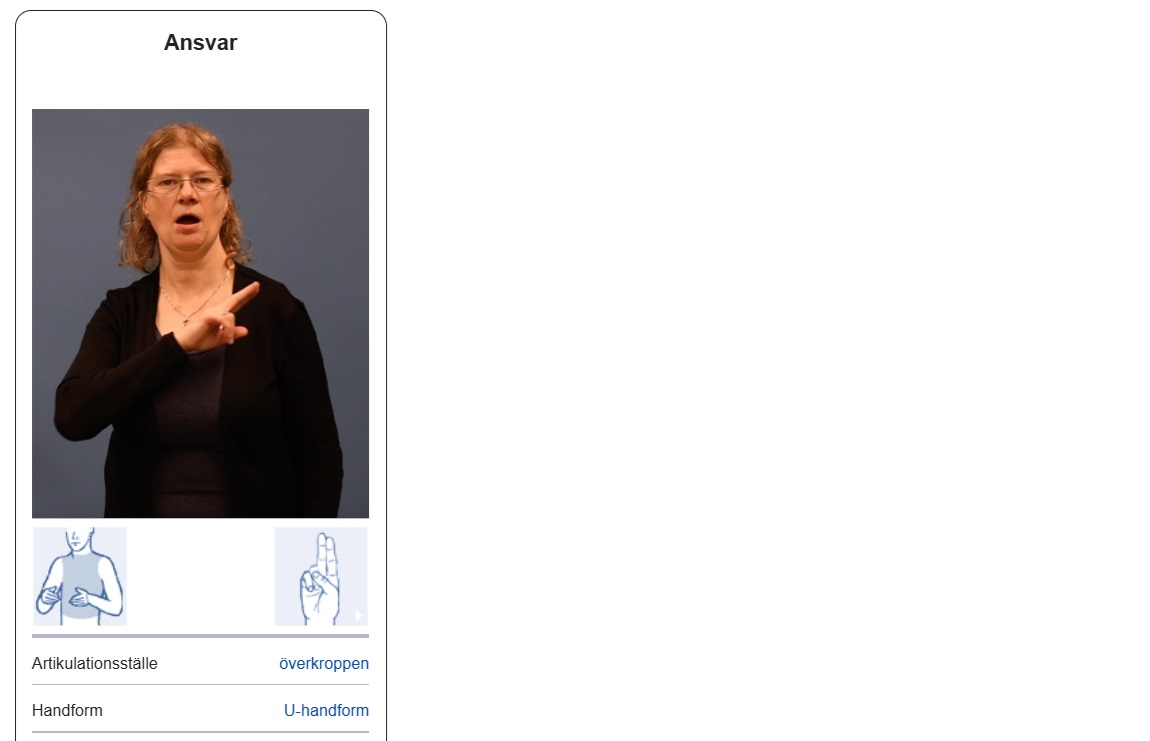 How to sign “responsibility” aka “ansvar” in Finland-Swedish Sign Language as well as “vastuu” in Finnish Sign Language. Source: https://finssl.signwiki.org/index.php/Ansvar.
Thirdly, I would like to see my students learn to present their endeavors in a comprehensible manner that serves the listeners / readers – whether these be natives, foreign language users residing in Finland or, for example, people with dyslexia.
Finally, I would like my students to see how language, language use, and the words they choose to use can pave their ways both on a personal level and on a professional level.
Of course, I would like my students to find the joy of learning foreign languages, stop being afraid of making mistakes and, instead, concentrate on conveying their message.
Sustainable language teaching meets technological challenges
When it comes to sustainability and language teaching, Humak seems to be among the pathfinders and forerunners. The profession-oriented language courses’ sections reflect the structure of the curricula of the different degree programmes; participatory and activity-based teaching methods are applied; and the different aspects of sustainability – environmental, economic, social, cultural and human – are explored so the students learn to discuss them in both English and Swedish. The teaching is, I dare to say, based on research and the basic values of humanism.
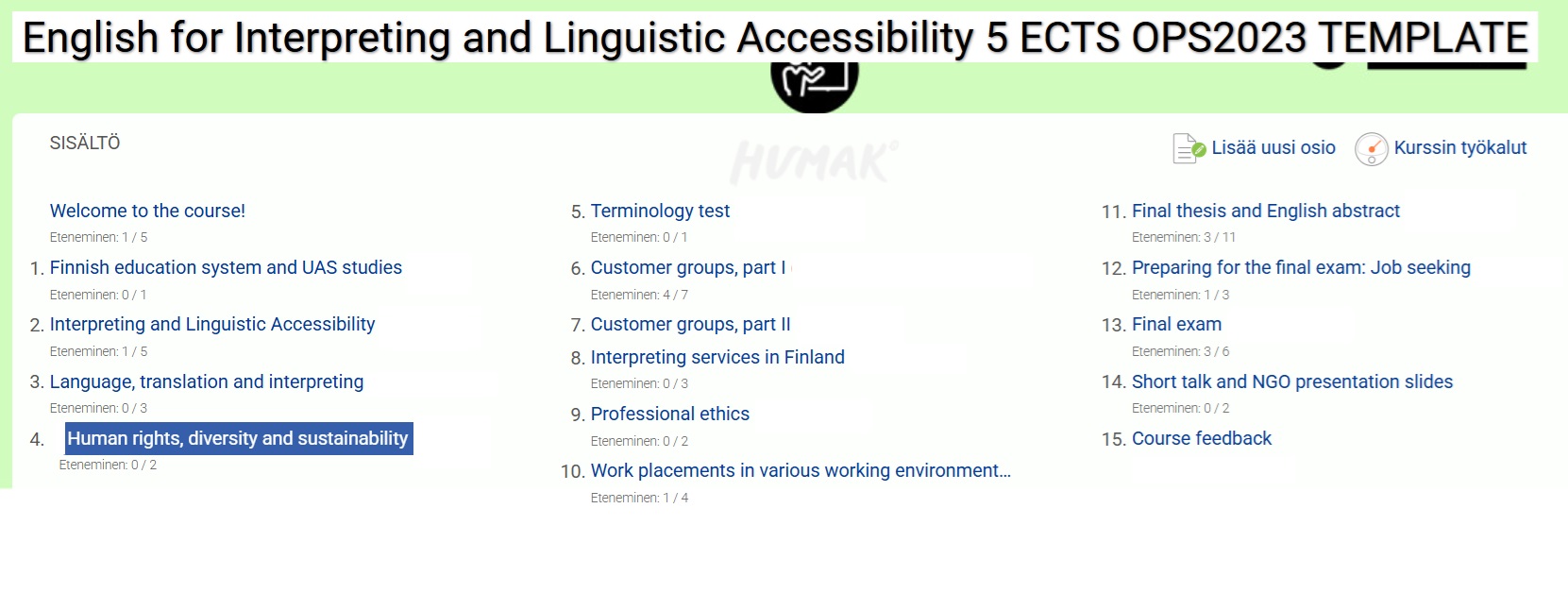 The Moodle template of the English course for the Degree Programme in Interpreting and Linguistic Accessibility: Section 4 – Human rights, diversity and sustainability.
However, we do miss the tools that would promote the ethics of our assessment practices: the final exams in Swedish and English and the assessment of students’ language skills are, unfortunately, not built on a sustainable basis – yet: it has proven extremely difficult to find the technology we need for carrying out exams online. This is why, during this autumn, some of the Humak language exams will be carried out in an old-fashioned manner in the physical classroom – not with pen and paper, though.
Addressing sustainability challenges and advocating for change
In my opinion, the real responsibility for addressing the climate crisis and broader sustainability challenges lies in basic and upper secondary education and at homes. At Humak, we educate young adults, mostly, so we take on where primary and secondary education and their homes left, and aim to make the students understand that they are part of our society – and, in particular, that they are part of building our society as future professionals, as they will convey their ways of working and communicating to the next generations.
We have a duty to advocate for change within our institution and discipline regarding sustainability. However, I think that our UAS has, through the new curricula, made us advocate for change, but until now, we have needed to find our methods, contents and ways ourselves – which seems to be the case in higher education institutions and among other language teachers, as well. In practice, we were all, quite suddenly, required to implement something called sustainable teaching – perhaps not quite knowing the range of aspects it entails. When I, as a language teacher, really start to think about language teaching and sustainability, it blows my mind: language and language use might, in fact, lay the very foundation for responsibility and sustainable development.
The two-word definition for responsibility
Back to the two-word definition of responsibility. Since I did not quite believe in the functionality or even the comprehensibility of a two-word definition for responsibility, I first let ChatGPT summarise my lengthy answers, some of which you have just acquainted yourself with, into approximately 25 words:
“As a university lecturer, my responsibility is to promote inclusive, sustainable communication, support students’ growth, and drive change in education and society.”
Then, finally, I was – ta-da! – ready for my two-word summary of what responsibility means to me: “Growth and sustainability”. Quite clever, I must say: I do not know whether this, perhaps, was the purpose of making us squeeze our answer into one or two words: to realise that sustainability is responsibility. Is it really that simple?
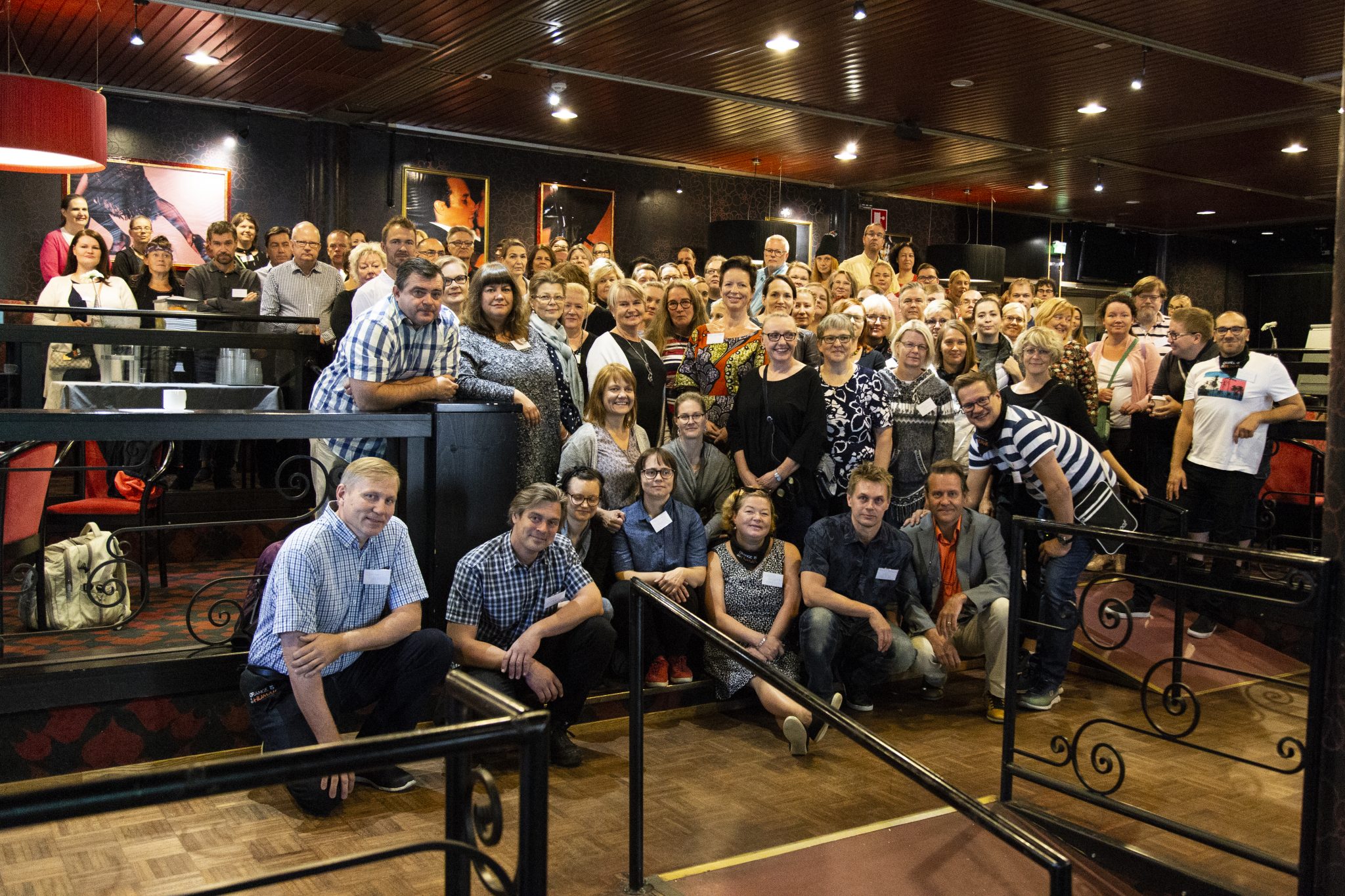 Responsible Humak staff at the annual workplace community development days. This year’s topic will be Responsibility and Sustainable Development.
Author:
Eeva Förbom, MA, Senior Lecturer, Humak University of Applied Sciences
Published: 2025/08/11
Publications (Articles, Blogs & Podcast)
- Blog
- Research and Development
- Resilient Societies
Art projects to strengthen the social inclusion of immigrant women
- Article

- Community Educator
From Instructor to Co-Creator: Participatory Pedagogy in Community Education
- Blog
- Creative Field Entrepreneurship
When IP Travels: Collaboration Builds New Audiences
- Blog